 Immutablex
 supported Ethereum NFT minting and trading before its shutdown
Immutablex was an Ethereum layer 2 network for minting, transferring, and trading NFTs through StarkEx, a validity-proof scaling engine. The network shut down on 11 February 2026. Immutable reported completing the automated migration of remaining eligible funds to Immutable zkEVM between 5 and 9 March 2026. That process excluded pending Ethereum withdrawals, which retained a separate finalisation path. Gas-free trades still carried trading fees, while developers accessed minting and other asset operations through predefined APIs.
Bottom line: Pending withdrawals initiated on or before 11 February 2026 remain legacy Ethereum bridge claims outside the completed automated fund migration.
Pending withdrawals stayed outside the automated migration
A withdrawal initiated on or before 11 February 2026 remains a legacy bridge claim if Ethereum finalisation has not occurred. Automated migration excluded those pending balances. The shutdown cutoff closed withdrawal initiation, while preserving finalisation for previously initiated withdrawals.
Eligible remaining fund balances followed the automated migration to Immutable zkEVM. Immutable reported completing that process between 5 and 9 March 2026. The migration also excluded balances associated with burnt assets.
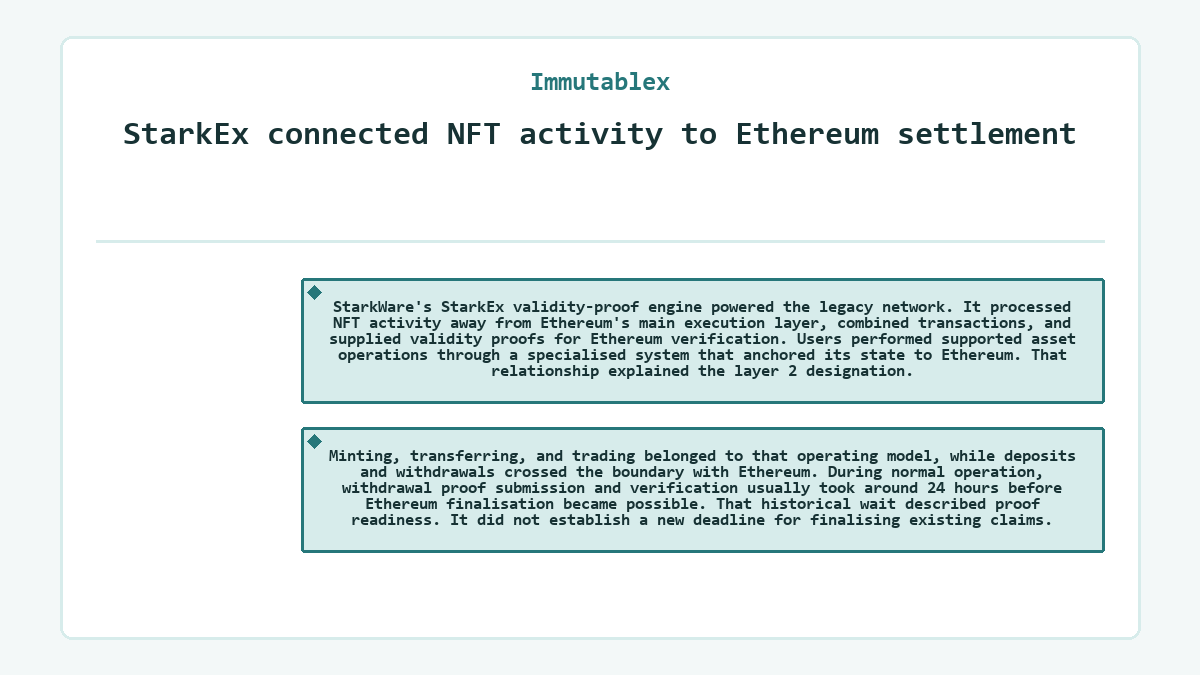
StarkEx connected NFT activity to Ethereum settlement
StarkWare's StarkEx validity-proof engine powered the legacy network. It processed NFT activity away from Ethereum's main execution layer, combined transactions, and supplied validity proofs for Ethereum verification. Users performed supported asset operations through a specialised system that anchored its state to Ethereum. That relationship explained the layer 2 designation. Minting, transferring, and trading belonged to that operating model, while deposits and withdrawals crossed the boundary with Ethereum. During normal operation, withdrawal proof submission and verification usually took around 24 hours before Ethereum finalisation became possible.
That historical wait described proof readiness. It did not establish a new deadline for finalising existing claims.
NFT minting relied on registered Ethereum contracts
Collection registration connected an Ethereum contract to the legacy NFT system, while layer 2 minting required additional contract methods. Developers first deployed their Ethereum contract, then registered the collection through self-service onboarding. The supported standards included ERC-721 for NFTs and ERC-20 for fungible tokens. An eligible contract with an owner could register without supporting
layer 2 minting. Contracts that needed that capability required the
mintFor
and
owner
methods. This separated bringing an existing collection into the system from creating tokens through its minting interface.
Predefined APIs handled asset operations, with SDKs helping applications use those interfaces. Collection owners authorised mint requests with signatures.
Shared orders connected marketplace trading and fees
Participating marketplaces placed orders into a shared order book, allowing a listing and its eventual trade to involve different marketplaces. The maker created an order, and the taker accepted it. These roles also explained why the marketplace that originated an order and the marketplace that executed it could receive different fees. Trade-related charges applied when the order successfully executed.
Gas-free layer 2 activity removed execution charges for supported operations that did not touch Ethereum, while completed trades still attracted commercial fees. The legacy protocol's 2% trading fee applied to the base trade price. Marketplaces could set maker and taker fees, and collection owners could set royalties. Those charges served different recipients and purposes. Total trading fees therefore included more than the protocol fee when other applicable charges accompanied the order.
Ethereum interactions had a different cost basis. Deploying an Ethereum contract, depositing assets, and finalising withdrawals incurred Ethereum gas costs. Contract complexity and network conditions affected those costs. The absence of layer 2 gas charges did not remove the costs of crossing between layers or paying trade-related fees.
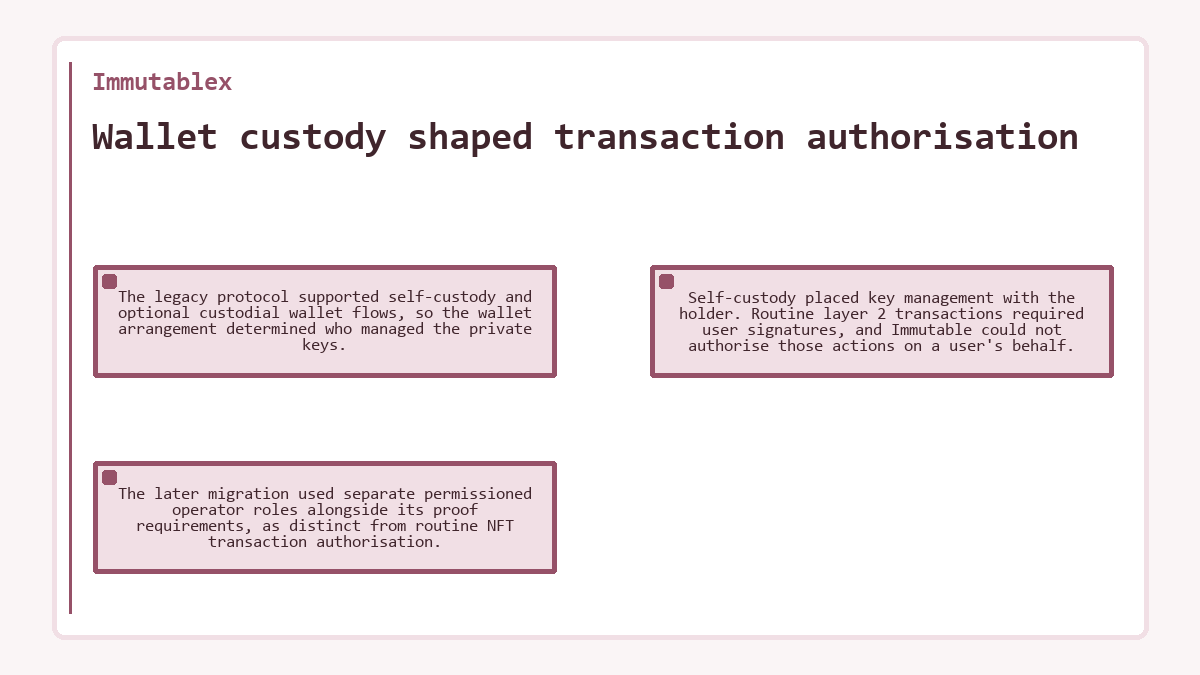
Wallet custody shaped transaction authorisation
The legacy protocol supported self-custody and optional custodial wallet flows, so the wallet arrangement determined who managed the private keys. Self-custody placed key management with the holder. Routine layer 2 transactions required user signatures, and Immutable could not authorise those actions on a user's behalf. The later migration used separate permissioned operator roles alongside its proof requirements, as distinct from routine NFT transaction authorisation.
Blueprints and dynamic metadata had different limits
A minting blueprint fixed token-specific data for the legacy withdrawal process, while dynamic metadata supplied descriptions and attributes through a collection endpoint. The
blueprint
string could not change after
layer 2
minting. When that token withdrew to Ethereum, the contract used its blueprint value. A collection's
metadata_api_url
identified the endpoint for dynamic metadata and could change through the API. These mechanisms addressed different parts of the asset's representation, so updating a description did not rewrite its blueprint.
Changes to off-chain metadata also required a refresh to update the indexed asset information. The legacy crawler fetched metadata at minting rather than continuously following every later edit. For legacy indexing and display on Immutable's marketplace, attributes needed top-level fields instead of a nested attributes object. That formatting constraint concerned metadata interpretation; it did not change the token's ownership or make its minting blueprint editable.
Legacy project limits applied at different levels
Project allowances and API response sizes constrained different activities in the legacy system, so their values belonged to different scopes. A wallet could own multiple projects, and projects could contain multiple collections. The documented defaults below describe that historical environment. Qualifying projects could obtain higher collection and mint-request limits; these figures were not universal ceilings or current launch allowances.
| Legacy parameter | Documented default | Limit or reset interval |
|---|---|---|
| Collections per project | 5 collections | Higher limits for qualifying projects |
| Mint requests per project | 50,000 requests | Allowance reset every 4 weeks |
| API results per page | 100 results | 200 results maximum per page |
Was Immutablex the same network as Immutable zkEVM?
Immutablex and Immutable zkEVM were distinct networks with different execution models, and the latter became the destination for the automated fund migration. The legacy StarkEx system exposed predefined asset operations through APIs. It did not provide general smart contract execution. Immutable zkEVM supported independent smart contract deployment and composability. Registering an Ethereum contract with the older system therefore differed from deploying a contract on the destination network. Their shared ecosystem did not make their contract interfaces interchangeable.
Final vault records anchored the fund migration
The migration architecture connected eligible legacy balances to destination tokens through the final StarkEx vault root, a cryptographic commitment to vault ownership at shutdown. A vault proof described a specific vault's owner, token, and balance beneath that root. This tied disbursement to the recorded ownership state rather than an operator's discretionary choice of recipient.
On Ethereum,
StarkExchangeMigration
handled ETH and ERC-20 fund migration and retained pending-withdrawal finalisation. The design separated those pending claims from eligible funds moving to
Immutable zkEVM. It also provided the final vault-root hashes that the destination contracts needed for proof checks.
Cross-chain adapters relayed root information through Axelar.
VaultRootSenderAdapter
supplied the sending component, while
VaultRootReceiverAdapter
received the roots on Immutable zkEVM. Moving this verification data supported the destination's ownership checks; it did not replace the separate movement and disbursement of funds.
On the destination network,
VaultWithdrawalProcessor
checked vault and account proofs and tracked disbursement state.
VaultEscapeProofVerifier
verified vault proofs, and
AccountProofVerifier
checked account ownership proofs.
BridgedTokenMapping
associated legacy asset identifiers with destination token addresses.
The migration design limited each legacy vault to one withdrawal or disbursement. Tracking that state prevented a second payment across migration phases.
Operator roles and account mappings defined the trust assumptions
Permissioned operators advanced fund migration and executed disbursements, while on-chain proof checks constrained which owners could receive the funds. The migration initiator had responsibility for progressing eligible transfers and excluding pending withdrawals and burnt assets. The disburser had responsibility for submitting proof-backed payments in a timely manner. Those checks did not remove the operational dependence on the roles that had to carry out the process.
Account mappings supplied another dependency because Stark keys needed associations with Ethereum addresses. The design derived those mappings from off-chain systems rather than a complete on-chain account registry. It required publication of the association data and commitment of an account root before the bridge upgrade. The relevant off-chain systems for creating and modifying accounts had to stop before that commitment. Nethermind Security audited the migration contracts in February 2026; the account-mapping and operator assumptions remained part of their design.
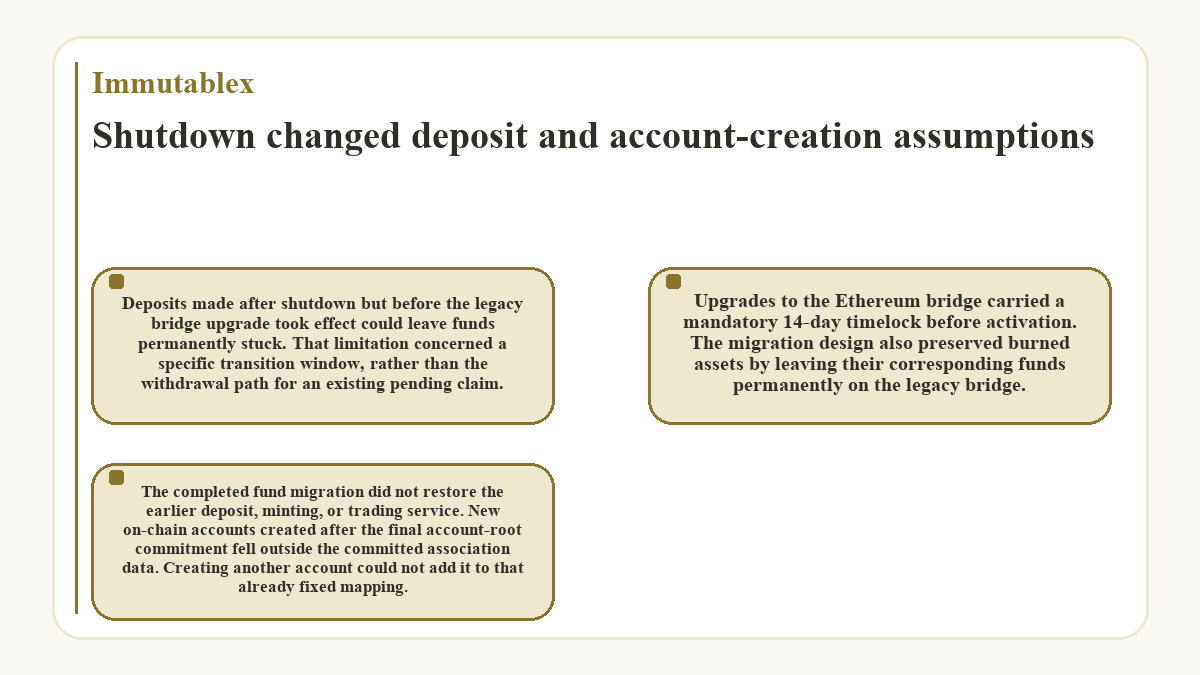
Shutdown changed deposit and account-creation assumptions
Deposits made after shutdown but before the legacy bridge upgrade took effect could leave funds permanently stuck. That limitation concerned a specific transition window, rather than the withdrawal path for an existing pending claim. Upgrades to the Ethereum bridge carried a mandatory 14-day timelock before activation. The migration design also preserved burned assets by leaving their corresponding funds permanently on the legacy bridge. The completed fund migration did not restore the earlier deposit, minting, or trading service.
New on-chain accounts created after the final account-root commitment fell outside the committed association data. Creating another account could not add it to that already fixed mapping.
Immutablex FAQ
Is marketplace blocklisting equivalent to deleting an Immutablex collection?
Marketplace blocklisting did not delete a collection from the legacy network. The protocol did not offer collection deletion after launch. Blocklisting a collection on Immutable's marketplace did not prevent other marketplaces from showing it.
Did Ethereum sales trigger the legacy layer 2 royalty?
The legacy layer 2 royalty did not apply to Ethereum layer 1 transfers or transactions. Collection owners set royalties during minting for the layer 2 system. That arrangement did not establish royalty enforcement on every network where an asset might later move or trade.
Was an API key mandatory for legacy integrations?
Legacy public API access did not require an API key. Immutable issued keys to managed partners, while other applications could use public endpoints within their rate limits. The APIs and SDKs were free to use, although successful trades and Ethereum transactions carried separate fee rules.
How did cursor-based pagination continue an inventory query?
The legacy API returned a cursor with result pages, and the next request supplied that cursor to continue the query. This let applications retrieve later results without treating the first page as a complete inventory. The page_size parameter controlled response size within the endpoint's documented maximum.
Why was the legacy mint method unsuitable for public frontend code?
The legacy mint method required the collection owner's signature, so frontend code that contained the owner's private key exposed that key. The signing process needed infrastructure that protected the secret. This restriction concerned the owner-authorised mint method, rather than every interaction that a browser application could perform.
What did the legacy API mean by stark_key and ethers_key?
The legacy API used stark_key for the layer 2 public address and ethers_key for the Ethereum wallet address. These identifiers described different sides of the account relationship. A public Stark key did not disclose the private signing key. The field names also did not make the two identifiers interchangeable across API methods.
Could a value field make a legacy mint require payment?
Adding a value field did not make the legacy minting API collect a required payment. Creators needed separate payment infrastructure for paid mints. That arrangement accompanied the owner-authorised mint request; gas-free layer 2 minting did not itself collect a customer's purchase price or define how the application charged for its tokens.
· last updated