 Immutablex
 withdrawals from pre-shutdown requests can still reach the registered Ethereum address
Immutablex withdrawals of ETH and ERC-20 tokens initiated on or before 11 February 2026 can still reach Ethereum through the legacy bridge. The withdraw function does not support NFTs. The network shut down on that date, while pending requests retained their finalisation route. The bridge sends funds to the Ethereum address registered for the relevant Stark key. These balances stayed outside the automated migration to Immutable zkEVM.
Finalisation depends on the correct network, the token's internal asset ID, and the Stark key's recipient mapping. A connected wallet does not choose the recipient. A missing registration can block payment even when a balance query confirms an outstanding claim.
The cutoff separated existing claims from new requests
11 February 2026 was the last day for manually initiating standard withdrawals from the legacy network. A request from that period can remain unfinished because initiation and Ethereum finalisation were separate operations. The preserved bridge function completes that earlier request; it does not start a new withdrawal from the retired network.
Eligibility also depends on the bridge's record for the specific Stark key and asset. A nonzero pending balance identifies funds awaiting finalisation. A zero result provides no balance to finalise for that query. It does not describe every token or another network.
Network and asset identifiers determine the balance query
Ethereum Mainnet and Sepolia Testnet use different bridge proxies. Production claims belong on Mainnet; testnet balances belong on Sepolia. Select the matching network and proxy before using the contract's Read as Proxy interface. A successful query on Sepolia cannot establish a Mainnet claim. The submitting wallet also needs that network's ETH for gas.
The
getWithdrawalBalance
read takes
ownerKey
, the Stark key in decimal, and
assetId
. The latter is the
token_int
value for the relevant token and network in the Asset ID reference tables of Immutable's Finalise Manually Initiated Withdrawals from Immutable X guide. The token contract address, ticker, and internal asset ID identify different things.
The later
withdraw
call labels that internal identifier
assetType
; the balance read labels it
assetId
. Preserve those parameter names when moving between the read and write interfaces. An ERC-20 contract address does not replace the documented
token_int
value.
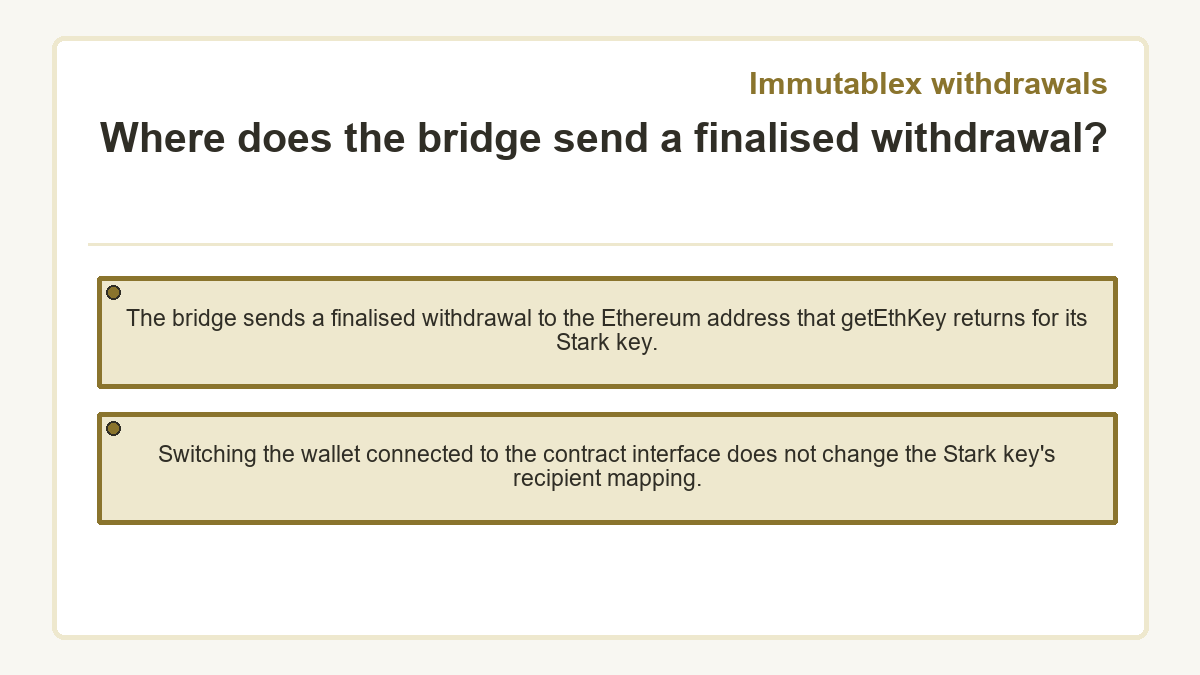
Where does the bridge send a finalised withdrawal?
The bridge sends a finalised withdrawal to the Ethereum address that
getEthKey
returns for its Stark key.
Switching the wallet connected to the contract interface does not change the Stark key's recipient mapping.
Interpreting the recipient mapping
A nonzero registered address
Finalisation uses the returned address, including an address for another wallet that you control. Existing registrations cannot change, so contact Immutable support if that address lies outside your control.
The zero address
A zero-address result means the bridge lacks a recipient registration for that Stark key, causing
withdraw
to fail with
USER_UNREGISTERED
. An outstanding pending balance does not supply the missing registration.
What restores withdrawals for an unregistered Stark key?
An unregistered Mainnet Stark key needs bridge registration before
withdraw
can finalise its pending balance. The registration route is available on Ethereum Mainnet only.
The Stark Key Registration Tool can recreate a legacy Stark key only if an Ethereum wallet signature originally generated it and you can use that original wallet. It then creates the required Stark signature locally, a step that an ordinary contract-explorer form cannot reproduce. The tool checks only the fungible tokens in the withdrawal guide's asset tables; pending withdrawals for other tokens will not appear.
Run the tool locally in a browser from Immutable's repository on your own computer. Immutable does not host this tool on a website. A public website asking for the legacy key-recreation signature is a phishing attempt, because that signature recreates the account's Stark key.
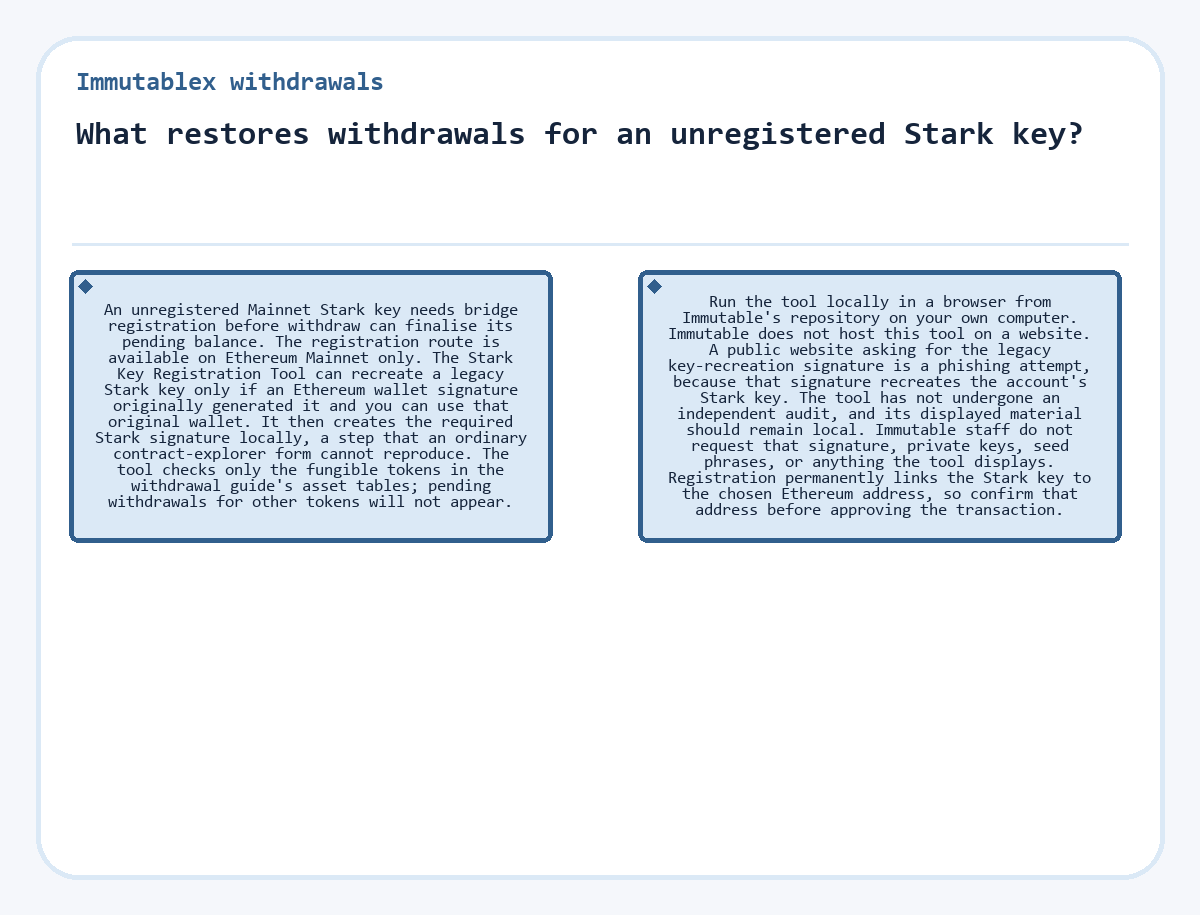
The tool has not undergone an independent audit, and its displayed material should remain local. Immutable staff do not request that signature, private keys, seed phrases, or anything the tool displays. Registration permanently links the Stark key to the chosen Ethereum address, so confirm that address before approving the transaction.
Finalise the selected asset and verify the recipient
The bridge's Write as Proxy interface exposes
withdraw
. Its
ownerKey
argument takes the decimal Stark key, while
assetType
takes the appropriate
token_int
. Connecting a wallet enables transaction submission and gas payment; it does not replace the registered recipient.
Finalisation concerns the selected pending asset. Inspect the transaction receipt and transfer details on the same Ethereum network. A transaction hash identifies the transaction; it does not prove successful execution. A successful receipt, together with the asset reaching the registered recipient, establishes payment.
A nonzero balance with a missing recipient
For this hypothetical case, assume access to the original Ethereum wallet whose signature generated the Stark key, an eligible pending ETH withdrawal on Ethereum Mainnet, a nonzero
getWithdrawalBalance
result, and a zero-address
getEthKey
result. The missing recipient registration is the immediate obstacle.
Calling
withdraw
immediately leaves the request unpaid: the contract reverts with
USER_UNREGISTERED
. Using the local tool to register that Stark key on the Mainnet bridge resolves the prerequisite, after which
withdraw
can finalise the pending ETH.
Suppose registration and the subsequent withdrawal both succeed. The withdrawal receipt reports success, and its ETH transfer credits the registered address, establishing payment for this example. A transaction hash without a successful result leaves completion unconfirmed; inspect its receipt before resubmitting.
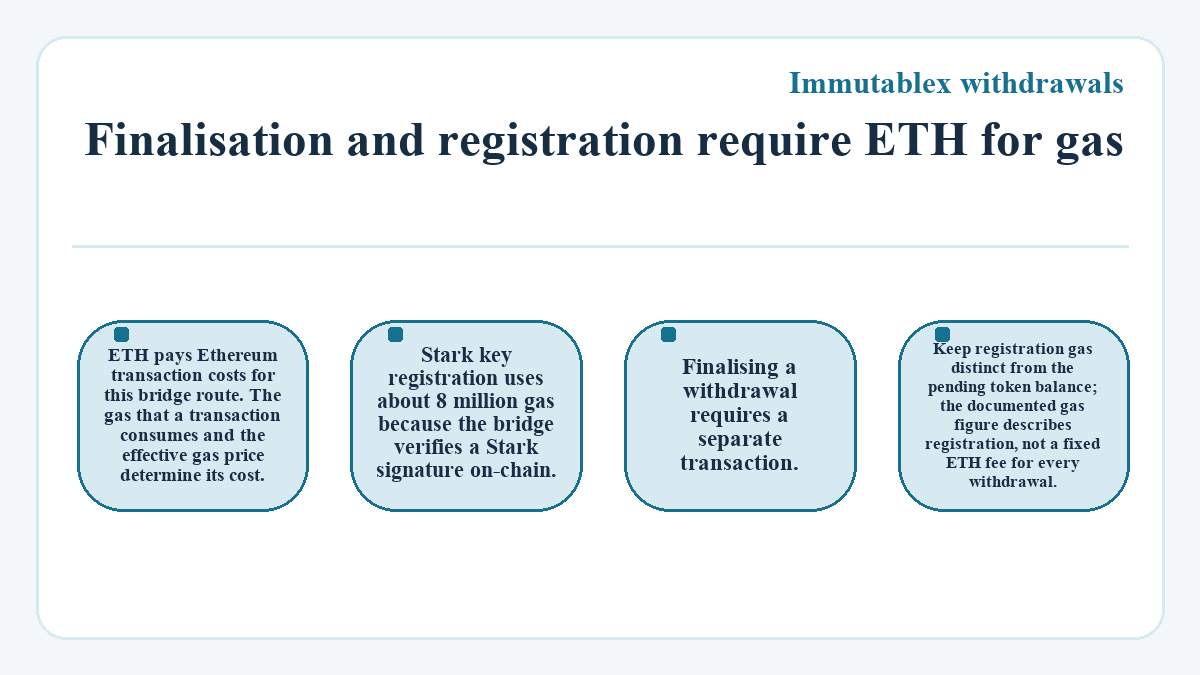
Finalisation and registration require ETH for gas
ETH pays Ethereum transaction costs for this bridge route. The gas that a transaction consumes and the effective gas price determine its cost. Stark key registration uses about 8 million gas because the bridge verifies a Stark signature on-chain. Finalising a withdrawal requires a separate transaction. Keep registration gas distinct from the pending token balance; the documented gas figure describes registration, not a fixed ETH fee for every withdrawal.
Manual finalisation remains separate from the completed migration
Immutable reported completing automated fund migration to Immutable zkEVM between 5 and 9 March 2026. That completion statement concerns eligible remaining funds and does not establish receipt in any particular account. Pending manually initiated withdrawals stayed on the Ethereum bridge, where finalisation follows a separate route from the completed zkEVM migration.
Key questions about Immutablex withdrawals
How can I recognise a standard StarkEx v4 key?
A standard StarkEx v4 key is the decimal representation of its Ethereum address. Some legacy accounts used a separately generated Stark key instead, so address conversion does not cover every account. The Stark Key Registration Tool can recreate a key only if it originally came from an Ethereum wallet signature and you can still use that wallet.
Can another wallet submit my pending withdrawal?
Anyone can call withdraw for a given Stark key, while the bridge sends the funds to that key's registered Ethereum address. The caller does not become the recipient merely by paying gas. Another wallet can therefore submit finalisation without changing the pending claim's recipient.
Why does OMI have two Mainnet withdrawal asset IDs?
OMI has two Mainnet entries because the bridge records different quantum values under different asset IDs. Both entries identify the same token contract. Check getWithdrawalBalance against each relevant ID when the applicable entry is unclear. The token symbol or contract address alone cannot distinguish those two bridge records.
What does NO_PENDING_WITHDRAWAL mean when finalisation fails?
NO_PENDING_WITHDRAWAL means that the selected Stark key and asset ID have no pending balance to withdraw. An incorrect asset ID can produce that result, and the withdrawal may already have finalised. Check the relevant network's token entries before treating the error as evidence about every asset in the account.
Did the historical 24-hour estimate include Ethereum finalisation?
The historical estimate described the usual wait for the layer 2 proof to reach Ethereum and pass verification. Users still had to finalise their withdrawal on layer 1 afterward. That operational estimate from the active network does not set a fresh waiting period or a finalisation deadline for an existing post-shutdown claim.
Does each pending Mainnet token require a separate Stark key registration?
Registration links a Stark key to an Ethereum address on the Mainnet bridge and does not repeat for every pending token. The registration tool uses one transaction for that association, followed by a withdrawal transaction for each pending token entry. Each withdrawal still uses its own asset ID.
· last updated