 Immutablex
 NFT minting required registered Ethereum contracts and collection owner signatures
Immutablex NFT minting created ERC-721 assets on layer 2 through registered Ethereum contracts and requests signed by the collection owner. Contracts for layer 2 minting needed the mintFor and owner methods. The legacy network shut down on 11 February 2026, so its minting workflow now describes a retired service.
Contract compatibility determined whether a collection could mint new tokens on layer 2; depositing existing Ethereum tokens had different requirements. Owner authorisation, request allowances, and mint-time settings then governed different parts of asset creation.
Key takeaway: Legacy deposits could use an ERC-721 contract with an owner, while layer 2 minting also required mintFor.
Contract registration connected Ethereum collections to layer 2 minting
Registering a compatible Ethereum contract connected a collection to the legacy platform's predefined asset operations. StarkEx did not support deploying arbitrary application contracts or running general computation through that registration. Applications used the minting API and SDK helpers to request asset creation.
Contracts for creating new tokens
An ERC-721 contract needed both
mintFor
and
owner
methods for
layer 2 minting. The owner method let the platform verify the contract owner. The bridge used mintFor to create the token on Ethereum during its first withdrawal from layer 2. The token standard alone did not satisfy those additional requirements. The Ethereum layer 1 contract had to exist before creators registered it through a project and collection. That registration connected the deployed contract to the collection that subsequent mint requests identified.
Contracts for depositing existing tokens
An ERC-721 contract with an owner could support registration without
mintFor
when the collection did not need layer 2 minting. This branch accommodated tokens that already existed on Ethereum. Depositing those tokens and creating new layer 2 tokens were different operations with different contract requirements.
Compatibility checks preceded registration and mint submission
A collection intended for new layer 2 mints first needed the required contract methods. Before deployment, its proposed implementation could still change. After mainnet registration, the platform did not offer collection deletion, making compatibility testing relevant before commitment.
| Stage | Historical operation | Authority or verification boundary |
|---|---|---|
| Contract preparation | Creators checked compatibility and deployed an ERC-721 contract on Ethereum when needed. |
Layer 2 minting required both
mintFor
and
owner
.
|
| Collection registration | Creators registered the deployed contract through a project and collection. | Registration identified the collection; minting still required owner authorisation. |
| Mint submission | The application submitted the collection owner's signed POST request to the minting endpoint. | The application needed to protect the owner's signing key. |
| Asset reconciliation | The application retrieved asset records using collection or recipient filters. | Returned asset records allowed comparison with the intended collection and owner. |
| Historical outcome | The compatible, registered collection provided the contract context for owner-authorised layer 2 mints. | |
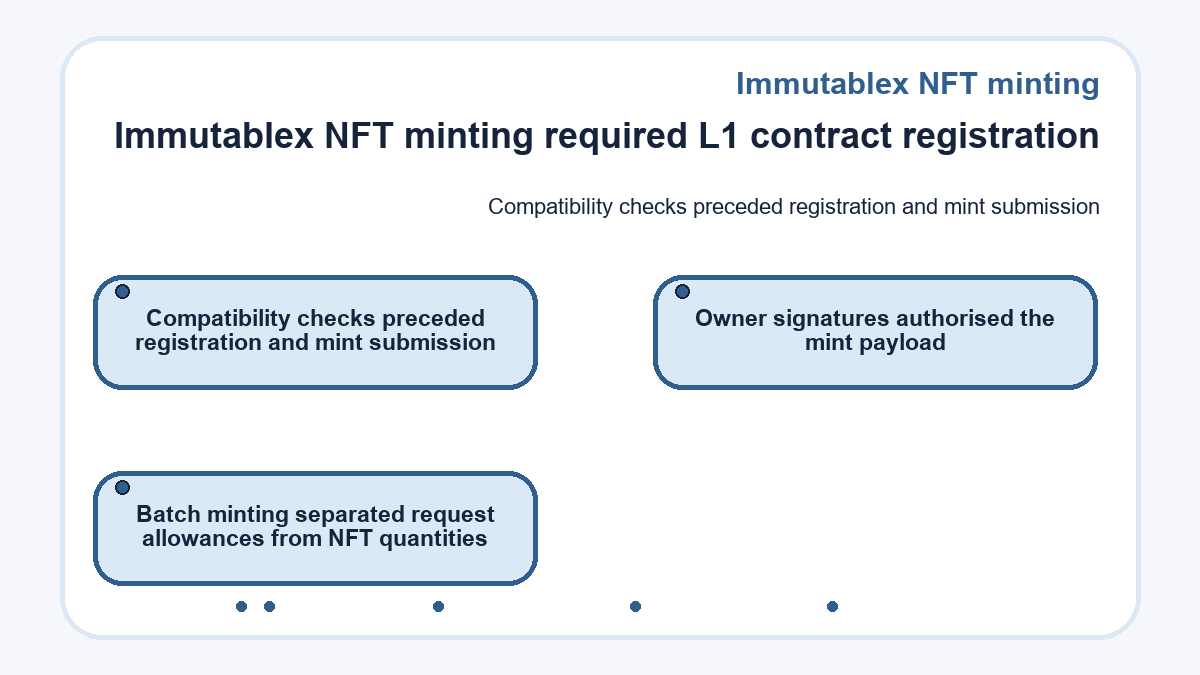
Immutablex NFT minting required L1 contract registration
- Compatibility checks preceded registration and mint submission
- Owner signatures authorised the mint payload
- Batch minting separated request allowances from NFT quantities
Asset reconciliation compared returned token records with the intended mint contents. Preparing or signing a payload alone did not establish completed minting. A collection that only supported deposits did not qualify for this new-token minting path.
Owner signatures authorised the mint payload
The legacy minting API required the collection owner's signature on each mint request. That requirement applied whether an application used SDK helpers or implemented the API call directly.
SDK preparation and API submission
The Core SDK's minting workflow assembled the contract address, recipient entries, and token data into a signable payload. It signed the payload and attached the authorisation signature before submitting the API request.
Signing keys and public frontend code
Putting the collection owner's private key into public frontend code exposed that key to visitors. A recipient address in the payload identified where tokens should go; it did not replace the owner's authorisation.
Batch minting separated request allowances from NFT quantities
The legacy v2 default allowance covered 50,000 mint requests per project in each four-week reset period. That allowance counted requests, not individual NFTs.
A single mint request could contain multiple tokens, so token quantity and request count could differ. Grouping tokens affected how many requests an application needed. The request allowance alone therefore did not establish a fixed maximum number of NFTs that a project could mint.
The v2 limits also allowed five collections per project by default. One wallet could own multiple projects, and a project could contain multiple collections. A collection count described project organisation, while a mint-request count measured use of the minting interface.
Support could increase the documented limits for projects that met its criteria. A large proposed collection did not automatically qualify for those increases. Both the default allowance and that adjustment process belonged to the legacy service.
Minting costs differed from Ethereum gas and trading fees
Layer 2 minting itself carried no gas charge during legacy operation, and the APIs and SDK were free to use. Any required Ethereum contract deployment incurred layer 1 gas costs. Contract complexity, optimisation, and Ethereum network conditions affected that deployment expense. The gas-free minting claim therefore did not describe the total cost of establishing a collection. Deposits and withdrawals also involved Ethereum gas.
Marketplace trading introduced a separate charging event after asset creation. The historical 2% protocol fee applied to successful trades, alongside applicable marketplace fees and collection royalties. Placing or viewing an order did not incur those trading fees.
Mint-time settings constrained later changes
In the legacy @imtbl/imx-sdk package (version 1.1.3 or later), the
mintV2
method supported setting royalties for collections and assets during minting. The older
mint
method predated royalty support.
Creators could specify royalty rates and recipients at collection or individual-token level. The legacy rules did not permit changing an already minted asset's royalty amount or recipient. Royalty recipients needed to be registered with the protocol before minting. Protocol enforcement applied to layer 2 trading; the legacy royalty rule did not extend to Ethereum layer 1 transfers or transactions.
Metadata followed separate rules. A token's minting blueprint remained fixed, while a collection's dynamic metadata endpoint could change. Editing display information did not provide a way to rewrite an existing asset's royalty configuration.
The shutdown ended the legacy minting route
The 11 February 2026 shutdown changed the first decision for any proposed collection: the legacy network no longer provided an active minting destination. Historical examples remained relevant to interpreting existing integrations, contract registrations, and mint records. Their presence did not establish that the old deployment and API sequence remained available for new launches.
Immutable zkEVM supported a different model with independent smart contract deployment and general computation. Its deployment model differed from registering an Ethereum contract with the legacy StarkEx service. A new collection targeting that network needed its applicable contract and minting requirements; the legacy registration requirements did not establish compatibility there.
Immutablex NFT minting: questions and answers
Did legacy NFT minting accept ERC-1155 collections?
Legacy v2 NFT minting used ERC-721, while ERC-1155 fell outside its documented supported token standards. The platform also supported ERC-20 fungible tokens. A marketplace's ability to display ERC-1155 metadata did not establish compatibility with the legacy minting protocol.
Was platform approval necessary to register a legacy NFT collection?
The legacy onboarding process was permissionless and did not require platform approval or vetting. Creators still needed self-service onboarding and a compatible registered contract. Permissionless access did not remove the collection owner's signature requirement or the project's default collection and mint-request limits.
How did an API key differ from the owner signature on a mint request?
An API key did not replace the collection owner's mint authorisation signature. The legacy API did not require an API key for ordinary access, and the platform issued keys to managed partners.
What limited the number of royalty recipients for a legacy NFT?
The legacy v2 fee rules allowed up to 50 royalty recipients and prohibited listing the same recipient more than once. This count concerned royalty recipients, not token recipients or the number of NFTs in a mint request. Marketplace maker and taker fee recipients followed separate rules.
Could a legacy Sandbox mint establish that an NFT existed on mainnet?
A Sandbox mint concerned the legacy test environment and did not establish mainnet asset creation. Sandbox had separate API, marketplace, and Link endpoints. A successful test mint therefore described that environment's result, even when an application used similar minting logic for a planned mainnet collection.
Were legacy mint-request quotas the same as API rate limits?
Mint-request allowances and API rate limits measured different constraints. The legacy v2 API rate without an API key was five requests per second, subject to change. A project's remaining mint allowance did not establish that it could submit API calls at any chosen speed.
· last updated